Best Grind for French Press: Why Coarse Is the Only Answer
French press coffee needs a coarse grind, coarser than what you would use for drip or pour over. The metal reusable filter in a French press cannot block fine particles the way a paper filter does, so fine grounds slip through and make the cup muddy and bitter. A consistent coarse grind also lets you press the plunger down smoothly without it jamming or blowing past the grounds.


Why Coarse Grounds Work With a French Press Filter
A French press uses a metal mesh plunger as its filter, not paper. That mesh has gaps large enough to let very fine particles pass straight into your cup. Coarse grounds are too big to slip through, so they stay on the right side of the filter when you press. The result is a clean separation between grounds and liquid, which is what gives French press coffee that heavy, rich body without the gritty sludge at the bottom. Drip and pour over brewers rely on paper to catch fine dust, so they can tolerate a medium grind. French press cannot.
How to Gauge the Right Coarseness
A good French press grind looks and feels like coarse sea salt or rough breadcrumbs. Each particle should be clearly visible and roughly the same size. If the grounds look like powdery flour or fine table salt, they are too fine. If they look like chunky cracked peppercorns with big uneven pieces, they are slightly too coarse and your brew will come out weak and watery. Aim for a uniform texture, consistency matters as much as particle size, because mixed grinds mean some particles over-extract while others under-extract, leaving you with a cup that tastes both bitter and sour at once.
Grind Size and Steep Time Work Together
Coarse grounds expose less surface area to hot water than fine grounds do, which is why French press calls for a longer steep, typically 4 minutes. If you grind too fine, the brew over-extracts fast and turns harsh even in that same 4-minute window. If you grind too coarse, the water barely touches the coffee and the result is thin and sour. Keep the steep time between 3.5 and 4.5 minutes and adjust grind slightly before you adjust steep time. Once you find your sweet spot with a given coffee, write it down, grind size is the single biggest variable you control.
Burr Grinder vs. Blade Grinder for French Press
A burr grinder cuts grounds to a consistent size, which is exactly what French press needs. A blade grinder chops randomly, leaving a mix of fine dust and large chunks in the same batch. That uneven mix is the most common reason a French press cup tastes wrong, the fines make it bitter while the large pieces stay under-extracted. If you only have a blade grinder, pulse in very short bursts and shake the grinder between pulses to even things out, but a burr grinder at any price point will get you more consistent results every time. For home brewers making one to four cups at a time, even an entry-level hand burr grinder is a noticeable upgrade.
Presses That Handle Coarse Grounds Well
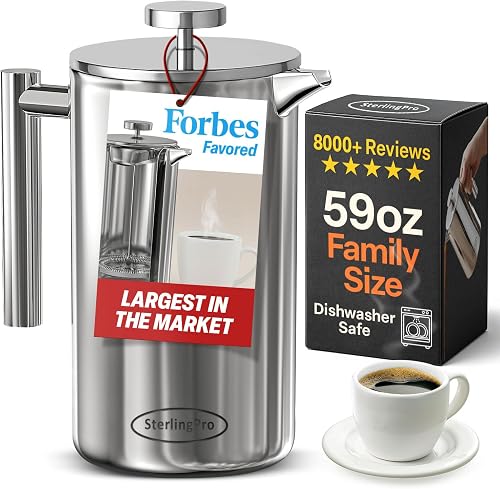
The Secura SFP-34DS (rated 4.7 stars across more than 35,000 reviews) uses a reusable metal filter and is designed specifically for ground coffee at the coarse end of the spectrum. Its 1-liter capacity makes it practical for brewing multiple cups in one press. The Coffee Gator SYNCHKG107962, also rated 4.7 stars with over 12,800 reviews, is built from 304-grade stainless steel and explicitly calls for a coarse grind to work with its reusable filter system. The SterlingPro SSFP goes a step further, it specifies coarse-ground coffee as its intended input and adds an extra filter screen to reduce sediment even at coarse settings, making it a good pick if you want an even cleaner cup.
What to Do If Your Grounds Are Too Fine
If your only option is pre-ground coffee labeled for drip or all-purpose use, you can still get a decent French press result, just shorten the steep to about 2.5 to 3 minutes and pour slowly once you press. You will still get some sediment in the cup, so either stop pouring before you reach the last half-inch or let the cup sit for 30 seconds so the fine particles settle before you drink. This is not ideal, but it is workable. The bigger issue is that fine grounds make the plunger harder to push, so go slowly and apply even, steady pressure to avoid spraying hot coffee.
Common mistakes to avoid
- Using medium or drip-grind coffee in a French press, which causes bitterness and makes the plunger hard to press down.
- Grinding inconsistently with a blade grinder and getting a mix of fine dust and large chunks in the same batch.
- Adjusting steep time to fix problems caused by wrong grind size, grind size should be fixed first.
- Pressing the plunger too fast or too hard, which pushes fine sediment through the filter and into the cup.
- Leaving the coffee sitting on the grounds after pressing, which lets it continue extracting and turns bitter, pour it into a carafe or mug immediately.
- Buying pre-ground coffee labeled coarse but not checking the actual texture, since brands vary widely on what they call coarse.
Frequently asked questions
Can I use regular pre-ground coffee in a French press?
You can, but most pre-ground coffee sold for drip brewing is a medium grind that is finer than what French press works best with. The result is usually a muddy, slightly bitter cup and a plunger that is hard to press. If it is all you have, shorten the steep time to 2.5 to 3 minutes and pour carefully to leave sediment behind.
How coarse is too coarse for French press?
If your grounds look like cracked peppercorns or small pebbles with a lot of variation in size, they are too coarse. The water will not have enough contact with the coffee and the brew will taste thin, sour, and under-developed. Aim for the texture of coarse sea salt, clearly defined particles, all roughly the same size.
Does grind size affect how long I should steep French press coffee?
Yes. Coarse grounds need more time, 4 minutes is the standard starting point. If you go slightly finer, shorten the steep to 3 to 3.5 minutes. The two variables are linked, but grind size is the more powerful one. Fix your grind before you start adjusting steep time.
Why is my French press coffee gritty even with a coarse grind?
A small amount of sediment is normal with any French press because the metal filter is not as fine as paper. If the grit is heavy, check that your grinder is actually producing a coarse, consistent output and not a mix of sizes. Also make sure you are not pressing the plunger all the way to the very bottom, which can push fine particles up through the filter.
Is French press grind different from pour over grind?
Yes. Pour over uses a paper filter that traps fine particles, so a medium grind works well and gives a clean, bright cup. French press uses a metal reusable filter that lets fine particles through, so it needs a coarser grind to keep the cup clear and the plunger easy to press. Using pour over grind in a French press almost always results in a bitter, muddy brew.