Stainless Steel vs Glass Electric Kettle: Which One Is Right for You?
Stainless steel electric kettles heat water fast, retain heat well, and handle daily use without showing water spots or buildup on the outside. Glass kettles let you see the water level and the boil in real time, which matters when you are steeping green or white tea that needs water pulled off before a full rolling boil. For most home coffee and tea drinkers, the choice comes down to one thing: do you need to watch the water, or do you just need it hot and ready?


How Each Material Affects Heat and Boil Speed
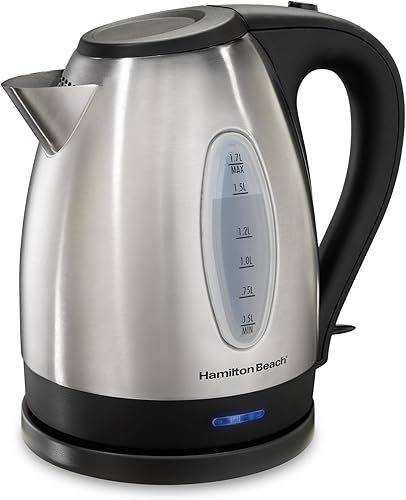
Both stainless steel and glass electric kettles draw from the same power source, so wattage drives boil speed more than material does. A 1500W stainless model like the Hamilton Beach 40880 will boil 1.7 liters in roughly the same time as a 1500W glass kettle at that capacity. Where material matters is heat retention after the kettle is lifted off its base. Stainless steel walls are better at holding temperature for a minute or two while you set up your pour over dripper or gooseneck pouring position. Glass loses heat slightly faster because it is a poorer insulator, which is rarely a problem in practice but worth knowing if you are juggling multiple cups in sequence.
Visibility: Why Glass Wins for Temperature-Sensitive Brewing
Glass kettles let you watch the water as it heats, which is genuinely useful for delicate teas. Green tea, white tea, and some oolongs call for water in the 160-185 degree range, well before a full boil. Without a temperature control setting, a glass body lets you catch the small pearl bubbles that appear around 170 degrees and pull the kettle then. The Ovente KG83B uses borosilicate glass with a stainless steel base and lid, holding 1.5 liters at 1100W, and the clear body makes that visual check easy without any guesswork. Stainless kettles hide the water completely, so you are relying on auto-shutoff at boiling or a built-in thermometer if the model has one.
Durability and Daily Wear
Stainless steel handles bumps better than glass. A borosilicate glass kettle is tougher than standard glass and resists thermal shock, but it can still crack or chip if knocked against a hard surface. Stainless dents before it breaks, and most home users will never dent a decent-gauge kettle. For households with kids, a shared kitchen, or anyone who tends to set things down fast, stainless steel is the safer long-term bet. That said, quality borosilicate glass kettles have earned strong track records with home brewers, and basic care goes a long way.
Cleaning, Descaling, and Limescale
Hard water leaves mineral deposits inside every electric kettle regardless of material, so you will need to descale both types on a regular schedule. The process is the same for each: fill with a diluted white vinegar or citric acid solution, let it sit, rinse well. Where stainless and glass differ is on the outside. Glass shows water spots and fingerprints immediately, and the interior discoloration from tannins in tea is visible through the walls. Stainless steel hides interior staining but can develop a slight metallic taste if you let scale build up too long without descaling. Brushed stainless finishes also show fewer surface smudges than polished chrome options.
Which Material Suits Your Brewing Style
For drip coffee and French press, where you just need boiling water fast, a stainless steel electric kettle is practical and unfussy. The Amazon Basics MK-M110A1A is a 1500W stainless model at around $25 with over 50,000 reviews and a 4.6-star rating, making it a reliable everyday option without a lot of features to manage. For pour over coffee or loose-leaf tea, where you pour slowly through a gooseneck spout and temperature matters, a glass kettle gives you real-time visual feedback that complements the precision of the brew method. Many serious pour over setups pair a glass carafe or glass-body kettle with a separate thermometer for that reason.
Price and Value Across Both Types
You can find solid kettles in both materials at similar price points. Budget stainless steel kettles start under $25, and budget glass kettles land in the same range. At the mid tier, around $30-60, both materials offer better build quality, tighter lids, and cleaner spout design. Thermal or double-walled stainless kettles that keep water hot for longer cost more and are a separate category worth considering if you frequently make multiple cups over an extended stretch. Glass kettles rarely come in a thermal version because the design requires a transparent body, so if heat retention over time is a priority, stainless is the direction to go.
Common mistakes to avoid
- Choosing a glass kettle without checking if it is borosilicate, standard glass is more fragile and less heat-stable
- Assuming a stainless exterior means the interior is also all-metal, some stainless kettles have plastic interior components near the lid or spout
- Skipping descaling because the inside of a stainless kettle looks clean, limescale builds on the heating element regardless of what you can see
- Buying a glass kettle for temperature-sensitive tea but not checking if the model has a variable temperature setting or auto-shutoff below boiling
- Picking wattage without thinking about capacity, a 1000W kettle heating 1.7 liters takes noticeably longer than a 1500W model at the same fill level
- Overlooking the gooseneck spout option in both materials, for pour over brewing, the spout shape matters as much as the body material
Frequently asked questions
Does a stainless steel kettle affect the taste of water or coffee?
A well-made stainless steel kettle should not add any flavor to the water. If you notice a metallic taste, it usually means limescale has built up on the heating element and the kettle needs descaling.
Is borosilicate glass safe for boiling water every day?
Yes. Borosilicate glass is designed to handle rapid temperature changes and repeated heating cycles. It is the standard glass used in most glass electric kettles and is safe for daily use.
Which type of kettle is better for pour over coffee?
Either can work, but a stainless steel gooseneck kettle like the Bonavita BV382510V is a popular choice for pour over because the narrow spout gives you precise flow control over your drip brewer or pour over cone. A glass body is not required for good pour over results.
How often should I descale a glass vs stainless kettle?
The descaling schedule is the same for both: roughly once a month in hard water areas, every two to three months with softer water. The material does not change how quickly mineral deposits form on the heating element.
Can I see the water level in a stainless steel kettle?
Most stainless steel kettles have a small side window or a clear water-level indicator built into the handle so you can check capacity before boiling. You will not get the full visibility of a glass body, but you can still see the min and max fill lines.