Reusable Pods vs. Disposable Pods: A Plain-Language Guide for Single-Serve Drinkers
Reusable pods, small refillable baskets that hold your own ground coffee, cost a few dollars upfront and then brew for pennies per cup. Disposable K-Cup pods are pre-filled, sealed capsules you drop in and discard; they're faster to set up but run roughly three to five times more per cup. Most modern single-serve brewers support both, so the choice is really about how you weigh convenience against cost and coffee quality.


What Each Type Actually Is
A disposable K-Cup is a plastic capsule pre-loaded with ground coffee, a paper filter, and a foil lid. You snap it into the brewer, press a button, and toss it when done, no measuring, no cleanup. A reusable pod (sometimes called a reusable K-Cup filter or refillable capsule) is an open basket made of stainless mesh or plastic that you fill yourself with any ground coffee you like. Both types work in the same drip brewing principle: hot water is forced through the grounds and into your cup. The main functional difference is who does the prep work, the coffee brand ahead of time, or you in the morning.
Cost: The Numbers That Matter
A box of name-brand K-Cup pods typically runs $0.50 to $0.90 per cup. A quality bag of whole-bean or pre-ground coffee brewed through a reusable pod brings that down to roughly $0.10 to $0.20 per cup. A reusable pod itself costs $10 to $20 as a standalone accessory, many single-serve brewers include one in the box. If you drink two cups a day and switch from disposable pods at $0.65 each to ground coffee at $0.15 each via a reusable filter, you save about $30 a month. At that rate a $15 reusable pod pays itself off in under two weeks.
Coffee Flavor and Freshness
Reusable pods give you more control over flavor. You can choose any roast, grind size, and coffee origin, and you can buy beans fresher than the mass-market pods that sit on warehouse shelves. A medium grind works best for single-serve drip brewing, too fine and you get a slow, bitter pull; too coarse and the water rushes through without extracting much. Disposable K-Cups use a sealed foil top to slow staling, so they stay reasonably fresh for months, but the grind and roast are locked in by the manufacturer. If you care about tasting the difference between a light Ethiopian pour-over style and a dark French press roast, reusable pods open that door.
Convenience and Speed
Disposable K-Cups are genuinely faster on a busy morning: open the drawer, drop one in, press a button. No measuring, no rinsing, no digging grounds out of a filter basket. Reusable pods add about 60 seconds of prep, scoop, level, snap in, and another 30 seconds of cleanup afterward. For most people that's a minor difference, but if you're scrambling before a commute every day, the capsule's convenience is real. Brewers like the Keurig K-Mini Plus (rated 4.4 stars across nearly 40,000 reviews) are specifically built for that single-serve speed with full K-Cup compatibility and a 1500W heating element that reaches brew temp fast.
Waste and Environmental Impact
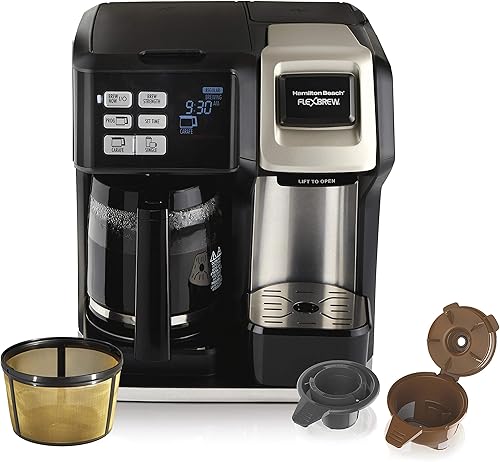
Billions of K-Cup pods end up in landfills every year. Most are made from a mix of plastic, foil, and organic material that standard recycling programs won't accept together. Some brands offer recyclable pods, but you have to peel the lid, empty the grounds, and sort them yourself. Reusable pods produce no single-use plastic waste, you rinse them and reuse them for years. If reducing plastic is important to you, this is one of the clearest wins in your kitchen. The Hamilton Beach 49950C is a good example of a brewer designed for both paths: it accepts K-Cup pods and includes a reusable filter basket that handles ground coffee directly, giving you the flexibility to switch between approaches depending on your morning.
Which Brewers Support Both Options
Many current single-serve drip machines include a reusable filter in the box or list pod compatibility alongside ground-coffee support. The Keurig K-Select (4.6 stars, over 37,000 reviews, 1500W) is a fully automatic K-Cup brewer that also works with the Keurig My K-Cup reusable filter, letting you toggle between disposable and reusable on any given morning. The Hamilton Beach 49950C goes a step further with built-in dual input, K-Cup pods on one side, ground coffee through a reusable filter on the other, all at 1050W in a compact 4.4 lb frame. If you're not ready to commit to one pod type, a brewer that handles both is the practical middle ground.
Common mistakes to avoid
- Using too fine a grind in a reusable pod, it clogs the mesh filter and produces bitter, slow-drip coffee; aim for a medium grind similar to drip coffee.
- Overfilling the reusable pod above the max-fill line, which causes grounds to escape into the cup or jam the needle.
- Expecting reusable pods to produce the same cup volume as disposable K-Cups, they can, but you may need to adjust your scoop to dial in the strength.
- Buying a reusable pod that doesn't match your brewer's capsule size, K-Cup reusable filters are not universal across all single-serve brands and pod formats.
- Skipping the descale step because you switched to reusable pods, mineral buildup affects brew temperature and capacity regardless of pod type, so follow your brewer's descale schedule.
- Assuming all disposable pods are compatible with every single-serve brewer, K-Cup pods, Nespresso Original capsules, and other formats use different sizes and puncture mechanisms that aren't interchangeable.
Frequently asked questions
Can I use any ground coffee in a reusable pod?
Yes. Any pre-ground coffee works, and so does coffee you grind yourself at home. A medium grind is the sweet spot for single-serve drip brewing. Espresso grind is too fine and will clog the filter; a very coarse French press grind will under-extract and taste weak.
Do reusable pods fit all single-serve brewers?
No. Reusable pods are format-specific. K-Cup reusable filters fit Keurig and K-Cup-compatible brewers, while Nespresso-compatible reusable pods fit Original-line Nespresso machines. Always check that the reusable pod lists your specific brewer model or pod format before buying.
Does using a reusable pod change how I need to clean the brewer?
Mostly no, but you should rinse the reusable filter basket after every use to prevent old grounds from turning rancid. You still need to descale the brewer on the same schedule as with disposable pods, reusable filters don't affect mineral buildup from the water.
Are there disposable pods that are better for the environment?
Some brands sell compostable or recyclable pods, but the recycling process usually requires you to separate the lid, grounds, and plastic body before placing anything in the correct bin. Truly compostable pods need an industrial composting facility, not a home compost pile. Reusable pods remain the lower-waste option by a wide margin.
Will a reusable pod make the same size cup as a K-Cup?
Yes, as long as you select the same brew size on your machine. The brewer pushes the same volume of water through regardless of pod type. Adjust how much ground coffee you add, typically one rounded tablespoon per 8 oz cup, to match the strength you're used to from disposable pods.