How Long Does an Electric Kettle Take to Boil?
Boil time depends on a few key factors, and knowing them helps you pick the right kettle and manage your morning routine.
Most electric kettles boil a full load of water in two to five minutes, which is noticeably faster than a stovetop pot. That range exists because wattage, water volume, starting water temperature, and even altitude all play a role. If your kettle feels slow, it may not be broken, it may just be working with what it has. This guide breaks down the real numbers and tells you what to look for when speed matters.


The Short Answer: 2 to 5 Minutes for Most Kettles
A typical 1500-watt electric kettle brings a full 1.7-liter load from room temperature to a rolling boil in roughly three to four minutes. Smaller amounts of water, say half a liter for a single mug, boil in closer to one and a half to two minutes. Lower-wattage models (around 1000 watts) take longer, often five to seven minutes for the same full load. Higher-wattage models (1800 watts and above) can shave a minute or more off that time. So if you regularly boil large volumes, wattage is the spec to pay the most attention to.
How Wattage Affects Boil Time
Wattage is the single biggest factor in how fast an electric kettle heats water. More watts means more energy delivered to the water per second, which translates directly to faster boiling. In the US, most home electric kettles run between 1000 and 1500 watts because that is what standard 120-volt outlets support. Some travel kettles run at 700 watts or less and are noticeably slower. If you see a kettle advertised as 1500W in the US, that is basically the maximum you will get from a standard wall outlet, and it is the sweet spot for balancing speed and everyday use.
Water Volume Makes a Big Difference
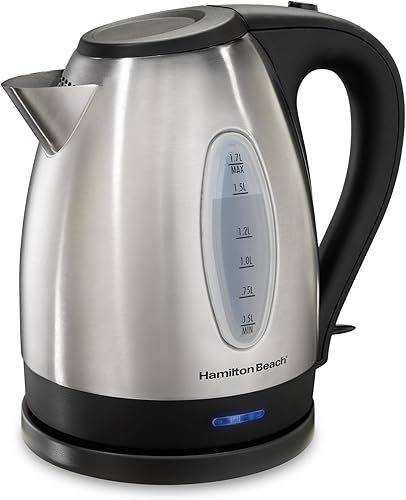
The less water you boil, the faster it gets there. If you only need one or two cups, filling the kettle to the minimum line instead of the maximum can cut your wait time roughly in half. Most kettles have a minimum fill mark, usually around 0.5 liters, for good reason: boiling less than that risks damaging the heating element. For a quick single serving, just fill to that minimum line and you will be done in well under two minutes on a 1500-watt model.
Starting Water Temperature Matters Too
Cold tap water in winter and room-temperature water in summer are not the same thing. If your tap water comes out near freezing, the kettle has more degrees to cover before it hits 212 degrees Fahrenheit. On a cold morning, expect an extra thirty seconds to a minute compared to a milder day. This is why some people keep a small amount of leftover hot water in the kettle from the previous boil, pre-warmed water gets back to boiling significantly faster.
Does Altitude Slow a Kettle Down?
Water boils at a lower temperature at high altitudes because there is less atmospheric pressure pushing down on it. At 5,000 feet, water boils around 202 degrees Fahrenheit instead of 212 degrees at sea level. An electric kettle's thermostat is designed to detect the boil, so it will actually shut off a little sooner at altitude, meaning the water reaches its boiling point (the lower one) in slightly less time. For most brewing purposes this matters more for coffee quality than for speed, but it is worth knowing if you live somewhere high up.
What Slows a Kettle Down Over Time
Limescale is the main culprit. Hard water leaves mineral deposits on the heating element, and those deposits act as insulation, making the element work harder and heat the water more slowly. If your kettle used to be faster than it is now, descaling it with citric acid or diluted white vinegar is often all it takes to restore normal boil times. Regular descaling, every one to three months depending on your water hardness, keeps the kettle running at its rated speed.
Kettle Picks That Boil Fast
If speed is a priority, look for a 1500-watt model with a capacity that matches how much you actually boil. The Mueller MLR0020 runs at 1500 watts with a 1.8-liter capacity and has over 63,000 reviews, making it one of the best-selling kettles available. The Amazon Basics MK-M110A1A is another 1500-watt option at a lower price point, with over 50,000 reviews and consistently solid ratings. For a mid-range stainless option, the Hamilton Beach 40880 also runs at 1500 watts and weighs just 2.2 pounds, so it is easy to handle when full. All three represent the typical 1500-watt ceiling for US outlets, which is the fastest you can reasonably expect at home.
Frequently asked questions
How long does it take a 1500-watt kettle to boil 1 liter of water?
A 1500-watt kettle typically brings 1 liter of room-temperature water to a rolling boil in about two to two and a half minutes. Starting with colder tap water can add another thirty seconds or so.
Why is my electric kettle taking so long to boil?
The most common reason is limescale buildup on the heating element. Descaling with citric acid or diluted white vinegar usually fixes it. If the kettle is older and descaling does not help, the heating element may be wearing out.
Is it faster to boil water in an electric kettle or on the stove?
An electric kettle is almost always faster. A 1500-watt kettle is more efficient at transferring heat directly to the water than a gas or electric burner heating a pot from the outside.
Does the material of the kettle affect how fast it boils?
Not meaningfully. Whether the body is glass, stainless steel, or plastic, the heating element does the work. Wattage and water volume matter far more than the kettle's outer material.
Can I boil just one cup of water in an electric kettle?
Yes, as long as you fill above the minimum fill line marked on the kettle, usually around 0.5 liters. Boiling less than the minimum can damage the heating element, but boiling one or two cups worth is fine and will be noticeably faster than filling it all the way.