Pour-Over Coffee Ratio Guide: How Much Coffee to Use
The right coffee-to-water ratio is the single biggest variable you control in pour-over brewing.
Pour-over coffee is simple in concept but easy to get wrong on the numbers. Too little coffee and the brew tastes watery and flat; too much and it can turn harsh or overpowering. The good news is that nailing the ratio is mostly a matter of knowing a reliable starting point and making small adjustments from there. This guide gives you clear numbers to work with and explains how to tweak them to match your beans and your taste.


The Standard Starting Ratio
The widely used starting point for pour-over coffee is 1:15 to 1:17 by weight, meaning 1 gram of coffee for every 15 to 17 grams of water. A ratio of 1:16 sits in the middle and is a solid default for most beans and most palates. For a single 12-ounce mug, that works out to about 22 grams of coffee and 350 grams of water. Measuring by weight rather than volume is worth the small effort because ground coffee compresses differently depending on grind size, making volume scoops unreliable.
Why Weight Beats Volume Every Time
A standard tablespoon of coffee can hold anywhere from 5 to 7 grams depending on how fine or coarse the grind is. That kind of variation makes it hard to reproduce the same cup twice. A kitchen scale removes the guesswork entirely and lets you dial in adjustments in small, repeatable steps. If you decide to go slightly stronger next time, adding 2 grams of coffee is a precise change you can track. Changing from one scoop to one heaping scoop tells you almost nothing about what actually changed.
Quick Reference: Common Brew Sizes
Here are some practical numbers using a 1:16 ratio to get you started. For a single small cup of about 8 oz (240 g water), use 15 g of coffee. For a standard 12 oz mug (360 g water), use 22-23 g. For two 12 oz mugs or a large travel mug (720 g water), use 45 g. For a full Chemex-style carafe producing 40 oz (1,200 g water), use 75 g. Round to the nearest gram; that level of precision is more than enough.
How to Adjust for Strength
If your cup tastes weak or watery, add 2 to 3 grams more coffee while keeping the water volume the same, which tightens the ratio toward 1:14 or 1:13. If it tastes harsh or too intense, drop 2 to 3 grams of coffee or add a little more water to loosen the ratio toward 1:18 or 1:19. Make one change at a time so you know what actually moved the needle. It usually only takes two or three small adjustments before you land on a ratio you want to stick with.
Light vs. Dark Roast: Does the Ratio Change?
Roast level does affect extraction, so small adjustments can be useful. Light roasts are denser and extract more slowly, so some brewers prefer a slightly tighter ratio like 1:15 to draw out more flavor. Dark roasts extract faster and can turn bitter quickly, so a slightly looser ratio like 1:17 or 1:18 gives you a smoother result with less risk of over-extraction. These are starting guidelines, not rules. If you like a strong dark roast, staying at 1:15 is perfectly fine; taste is the real measure.
Grind Size and Its Connection to Ratio
The ratio and the grind size work together. If you keep the ratio the same but grind finer, the water flows through more slowly and extracts more intensely, which can taste bitter. If you grind coarser, the brew flows faster and extracts less, which can taste thin. When you are changing your ratio to fix a weak or strong cup, check your grind first. A brew that tastes weak may need a finer grind rather than more coffee. Getting both variables in a reasonable range together produces the most consistent results.
Equipment That Makes Ratio Dialing Easier
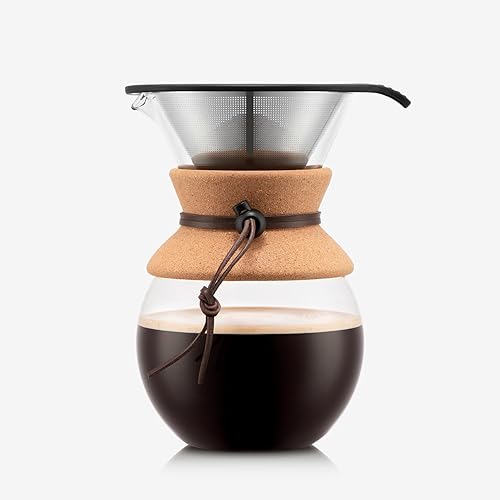
Any pour-over dripper works with these ratios, but some make the process more forgiving than others. The Hario V60-02W is a ceramic dripper with a paper filter that gives you good control over pour speed and extraction. The Chemex CM-6A uses a thicker paper filter that produces a cleaner, slightly lighter-bodied cup, which is worth knowing if you are comparing ratio results between brewers. The Bodum 11571-109US uses a reusable metal filter, which lets more oils and fine particles through and produces a fuller-bodied cup, meaning the same ratio will taste a bit bolder than with paper.
Frequently asked questions
What is the best coffee-to-water ratio for pour-over?
A 1:16 ratio by weight is a reliable starting point for most pour-over styles. That means 1 gram of coffee for every 16 grams of water. Adjust up or down by a few grams once you taste the result.
How many tablespoons of coffee should I use for pour-over?
Measuring by tablespoon is less precise than weighing, but as a rough guide, one level tablespoon of medium-ground coffee weighs about 6 grams. For a standard 12 oz cup at a 1:16 ratio you would need roughly 3 to 4 tablespoons, though using a scale is strongly recommended for consistency.
Can I use the same ratio for different pour-over brewers?
Yes, the ratio is a reliable baseline across brewers. Keep in mind that the filter type changes the final taste: paper filters produce a cleaner, lighter cup while metal filters allow more oils through for a fuller body. You may want to fine-tune your ratio slightly depending on which brewer you use.
What ratio should I use for a stronger pour-over?
For a stronger cup, move toward a 1:14 or 1:13 ratio by using more coffee relative to the water. Tighten the ratio gradually, two or three grams at a time, so you can taste the difference clearly at each step.
Does grind size affect how much coffee I should use?
Yes, grind size and ratio interact directly. A finer grind extracts more from the same amount of coffee, so you may want to use slightly less. A coarser grind extracts less, so you might need a little more. Start with a medium-coarse grind and adjust one variable at a time.