Best Grind Size for Pour-Over Coffee: What Actually Works
For most pour-over drippers, a medium-coarse grind is the right starting point. Grounds should look like coarse sand or raw sugar, not powdery like espresso and not chunky like French press. The exact setting depends on your specific dripper, your beans, and how fast water drains through the filter, but medium-coarse covers the majority of pour-over setups reliably.


Why Grind Size Matters So Much for Pour-Over
Pour-over is a manual drip method, which means water moves through the grounds by gravity alone. Grind size controls how fast that water flows. Too fine and the grounds pack together, slowing the drip to a crawl and over-extracting bitter compounds from the coffee. Too coarse and water races through before it can pull flavor out, leaving a thin, sour, under-extracted cup. Unlike a single-serve K-Cup machine or an automatic drip coffee maker, pour-over gives you no pressure assist, so the grind is the main lever you have. Getting it right is the single biggest factor in how the finished cup tastes.
The Medium-Coarse Sweet Spot
Medium-coarse is where most home brewers land after experimentation, and it works across the widest range of pour-over drippers. Picture raw cane sugar or rough sea salt: individual particles are visible and distinct, not clumped together. On a numbered burr grinder, this is typically somewhere between setting 18 and 25 out of 40, though every grinder is different. At this grind, a standard pour-over brew should take 3 to 4 minutes total from the bloom pour to the last drip, if your brew runs much faster or slower than that, your grind is the first thing to adjust.
How Your Dripper Shape Changes the Target Grind
The shape and filter type of your dripper affects how quickly water drains, which in turn changes the ideal grind. V-shaped drippers with a single large opening, like the Hario V60, drain fast, so you can go slightly finer than medium-coarse to keep water in contact with the grounds long enough. Flat-bottom drippers with multiple small holes slow the drain, so a true medium-coarse or even slightly coarser keeps the brew from getting too bitter. The Chemex CM-6A uses a very thick bonded paper filter that drains slowly by design, and many Chemex brewers grind a touch coarser than they would for a V60 to compensate. Knowing your dripper's drain rate is the fastest way to dial in your grind.
Paper Filters vs. Reusable Filters and Grind Adjustment
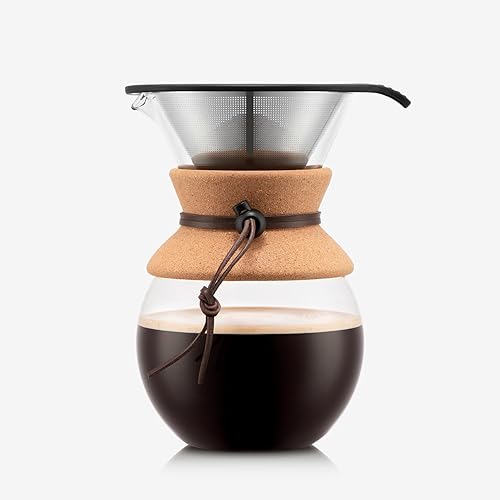
Paper filters add resistance to water flow, which typically means you can grind slightly coarser and still get full extraction. Reusable metal or mesh filters have larger pores and drain more freely, so a medium-fine grind often works better to keep the brew time in range and prevent a watery result. The Bodum 11571-109US uses a reusable filter, and owners usually find they need to grind a step or two finer compared to what they would use with paper. This is not a flaw, it just means the grind target shifts slightly depending on what you have in your filter holder.
Burr Grinder vs. Blade Grinder for Pour-Over
A burr grinder crushes beans between two abrasive surfaces and produces grounds of a consistent, uniform size, which is exactly what pour-over needs. A blade grinder chops beans randomly, producing a mix of fine dust and large chunks in the same batch. That uneven grind leads to simultaneous over-extraction of the fine particles and under-extraction of the coarse ones, and the cup ends up tasting muddy and off. For pour-over specifically, a burr grinder is worth the upgrade because the method is sensitive to grind consistency in a way that automatic drip machines simply are not. Even an entry-level hand burr grinder outperforms most blade grinders for this purpose.
How to Dial In Your Grind Step by Step
Start at medium-coarse and brew a full cup at your normal water temperature and dose. Taste the result and check your brew time. If the cup tastes sour or thin and the brew finished in under two and a half minutes, go one step finer. If the cup tastes bitter or harsh and the brew took more than four and a half minutes, go one step coarser. Change only one variable at a time, grind size only, not water temperature or coffee dose, so you know what caused the change in the cup. Keep notes on your grinder settings because beans from different roasters will often need a slight adjustment even at the same roast level.
Common mistakes to avoid
- Using a blade grinder and expecting consistent results, uneven particle sizes make it nearly impossible to dial in pour-over reliably.
- Grinding too fine for the dripper being used, which slows the drip so much the coffee over-extracts and turns bitter.
- Changing multiple variables at once (grind, water temp, dose) when troubleshooting a bad cup, making it impossible to know what actually fixed it.
- Assuming the same grind works for every bean, lighter roasts are denser and often need a finer setting than darker roasts to extract properly.
- Ignoring brew time as a diagnostic tool, if your pour-over consistently finishes outside the 3-to-4 minute window, grind adjustment is usually the answer.
- Not accounting for filter type, switching from paper to a reusable filter without adjusting the grind finer will often produce a thin, under-extracted cup.
Frequently asked questions
What grind size should I use for pour-over coffee?
Medium-coarse is the standard starting point, about the texture of raw cane sugar. Adjust one step finer if the cup tastes sour or brews too fast, one step coarser if it tastes bitter or brews too slow.
Can I use the same grind for a Hario V60 and a Chemex?
Close but not exactly. The Chemex uses a thick paper filter that slows drainage, so many brewers grind slightly coarser for a Chemex than they would for a V60. Start at the same medium-coarse setting and adjust based on brew time and taste.
Does it matter if I use a paper or reusable filter for grind size?
Yes. Paper filters restrict flow, so you can use a slightly coarser grind. Reusable metal or mesh filters drain faster and often work better with a grind a step or two finer than you would use with paper.
How long should a pour-over take to brew?
A typical pour-over should finish in 3 to 4 minutes from start to last drip, not counting the 30-second bloom. Faster than that usually means the grind is too coarse; slower usually means it is too fine.
Do I need an expensive grinder for pour-over?
You need a burr grinder, but it does not have to be expensive. An entry-level hand burr grinder in the $30 to $50 range produces far more consistent results than any blade grinder and is a better starting point for pour-over than spending more on a premium dripper while still using blade-chopped grounds.