Do You Need a Gooseneck Kettle for Pour-Over Coffee?
You do not absolutely need a gooseneck kettle to brew pour-over coffee. That said, the long curved spout of a gooseneck gives you a slow, steady, targeted stream that is much harder to achieve with a standard kettle, and that control directly affects how evenly your grounds bloom and extract. If you are brewing on a Hario V60 or a Chemex, where an uneven pour leads to channeling and a flat cup, a gooseneck is the single tool most likely to improve your results.


What a Gooseneck Spout Actually Does
A gooseneck kettle has a long, thin, curved spout that restricts flow to a narrow, low-velocity stream you can direct precisely over the coffee bed. With a standard kettle, the wide mouth releases water in a heavy gush that disturbs the grounds and rushes straight through before full extraction happens. For pour-over brewing, where you are manually controlling every variable, water temperature, pour rate, pour pattern, that fine-tuned flow control is the difference between a saturated, even extraction and an uneven one that tastes hollow or bitter. The gooseneck does not heat water differently or change the wattage; it only changes how the water lands on the grounds.
Which Drippers Demand More Precision
The Hario V60 is the poster child for drippers that reward a careful pour. Its single large drain hole and steep conical walls mean water flows through quickly, so if you dump in water unevenly you end up with dry pockets and channeling. The Chemex CM-8A, with its thick paper filter and open carafe design, also benefits from a controlled spiral pour during the bloom and subsequent pours, the capacity to brew larger batches makes an uncontrolled gush especially risky. Flat-bottomed drippers like the Kalita Wave are more forgiving because the three small holes slow the drain and even out minor pour inconsistencies, but even there a steady gooseneck pour helps you saturate the full grounds bed from edge to center.
When a Regular Kettle Can Work
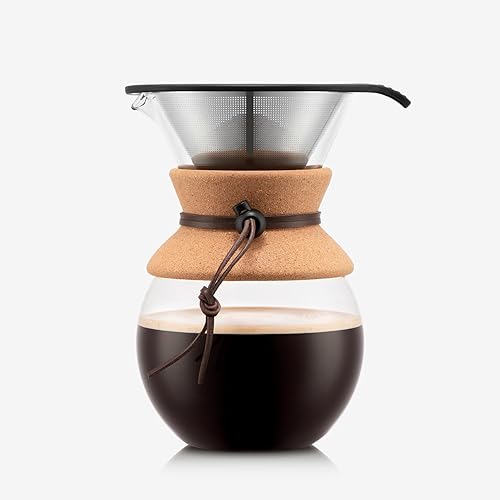
If you are just starting out with pour-over, a regular kettle will not ruin your coffee, it will just add an extra variable to manage. Pouring from a standard kettle more slowly by tilting it at a shallow angle can partially mimic a gooseneck stream, though it takes practice and the results are less consistent. Drippers with reusable mesh filters and wide, flat bottoms, such as the Bodum 11571-109US, are more tolerant of an imperfect pour because the metal mesh allows a slightly faster draw-down and the design does not rely on a tight spiral pour to work well. For someone who brews one or two cups in the morning and is not yet chasing a perfect extraction, a regular kettle is an acceptable starting point.
Temperature Control: The Other Half of the Gooseneck Case
Many electric gooseneck kettles let you set a target temperature and hold it, which matters for pour-over because water that is too hot over-extracts light roasts and too cool under-extracts dark ones. Most coffee experts recommend somewhere between 195 and 205 degrees Fahrenheit for drip and pour-over. A stovetop gooseneck kettle gives you the pour control but not the temperature precision, so you would need a thermometer or a separate step. An electric gooseneck with a temperature hold solves both problems at once, which is why it has become the standard pairing with a V60 or Chemex setup.
Recommended Pour-Over Drippers to Match Your Setup
The Hario V60-02W is the most popular ceramic pour-over dripper for home use, rated 4.8 stars across nearly 12,000 reviews, and it pairs naturally with a gooseneck kettle because the single-hole design rewards an even spiral pour. The Chemex CM-8A handles up to eight cups and is a strong pick for households brewing for several people, its thick bonded paper filter produces a clean, bright cup that benefits most from a controlled gooseneck flow. If you want something more forgiving while you build your pour technique, the Bodum 11571-109US uses a borosilicate glass body with a reusable stainless mesh filter and is dishwasher safe, making it a practical everyday dripper that tolerates a slightly faster pour without sacrificing too much in the cup.
The Bottom Line: Useful Tool, Not a Hard Requirement
A gooseneck kettle is the highest-impact upgrade you can make after you already own a decent dripper and a burr grinder. It does not replace good grind size or fresh beans, and a mediocre grind will still produce mediocre coffee no matter how precise your pour. Think of the gooseneck as something that eliminates the one variable you cannot compensate for with patience, water control during the brew. If you are serious about pour-over coffee and brew it more than a few times a week, the investment pays off quickly in more consistent cups.
Common mistakes to avoid
- Using water that is still at a full boil, letting it cool to around 200 degrees Fahrenheit before pouring avoids scalding light roasts.
- Skipping the bloom pour, adding a small amount of water first and waiting 30 to 45 seconds releases CO2 from fresh grounds and sets up an even extraction.
- Pouring all the water in one fast go instead of multiple smaller pours, which overwhelms the filter and causes channeling regardless of spout shape.
- Grinding too coarse for the V60, the single drain hole works best with a medium-fine grind; too coarse and water rushes through without extracting enough.
- Placing the dripper on a mug that is too short, causing the bottom of the filter to sit in pooled coffee and stall the drip before it is done.
- Ignoring the capacity of the dripper, brewing a single cup in a six-cup Chemex means the water-to-grounds ratio and pour timing both need to be adjusted, not just scaled down.
Frequently asked questions
Can I use a regular electric kettle for pour-over coffee?
Yes, you can. The main limitation is flow control, a standard kettle releases water faster and less precisely than a gooseneck, which makes it harder to do a controlled bloom or a slow spiral pour. For more forgiving flat-bottomed drippers the difference is smaller; for a Hario V60 the impact on extraction evenness is more noticeable.
What is the ideal water temperature for pour-over?
Most home brewers aim for 195 to 205 degrees Fahrenheit. Lighter roasts can take the higher end of that range; darker roasts brew more cleanly a few degrees lower. An electric kettle with temperature hold makes this easier to hit consistently without a separate thermometer.
Does the type of filter affect whether I need a gooseneck?
Yes, in a practical sense. Paper filters, used in the Hario V60 and Chemex, slow the drain and rely on an even pour to saturate the grounds bed properly. Reusable metal mesh filters drain faster and even out minor pour unevenness, making them somewhat more forgiving when using a standard kettle.
Is a stovetop gooseneck kettle good enough, or do I need electric?
A stovetop gooseneck gives you the pour control but not temperature precision. If you already own a thermometer and are comfortable pulling the kettle at the right moment, it works well. An electric model with a temperature hold removes that step entirely, which is why most regular pour-over brewers end up going electric.
How long should a pour-over take from first pour to last drip?
A typical single-cup V60 brew takes about 2.5 to 3.5 minutes total including the bloom. A larger Chemex batch brewing six or more cups can run 4 to 5 minutes. If your brew finishes in under two minutes, your grind is probably too coarse; over five minutes for a single cup usually means the grind is too fine or the filter is clogged.