Pour Over vs French Press: Which Brewing Method Should You Use?
Pour over and French press are both manual brewing methods that use ground coffee and hot water, but they produce very different cups. Pour over uses a paper or reusable filter set in a dripper, so the coffee drips through slowly and oils stay behind, giving you a clean, defined flavor. French press steeps grounds directly in hot water and uses a metal mesh plunger, leaving more oils and fine particles in the cup for a heavier, more textured result.


How Each Method Works
Pour over is a drip process: you place a dripper over your mug or carafe, set a filter inside, add grounds, and pour hot water in a slow controlled stream. A gooseneck kettle helps you aim the pour precisely and saturate grounds evenly. The water flows by gravity through the grounds and filter, and the brewed coffee collects below. French press works differently: you add coarsely ground coffee directly to the carafe, pour hot water over it, and let everything steep together for around four minutes. When the time is up, you press the metal plunger down to push the grounds to the bottom, then pour immediately.
Flavor and Cup Character
Because pour over uses a paper filter, oils and ultra-fine particles are caught before they reach your cup. The result is bright, clean coffee with well-defined flavors and a lighter body. Fruity or floral single-origin beans tend to show their best qualities through a pour over. French press skips filtration entirely, so coffee oils pass straight into the cup along with some sediment. That gives you a heavier, richer body with a more rounded bitterness. Darker roasts and blends built for boldness are well suited to the French press style.
Equipment and Cost
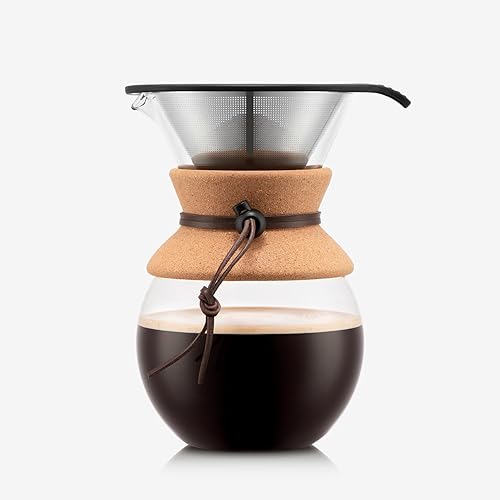
A basic pour over setup is inexpensive. The Hario V60-02W, a ceramic dripper rated 4.8 stars across nearly 12,000 reviews, is around $29 and brews up to 4 cups. A step up is the Chemex CM-6A at $47.95, a one-piece borosilicate glass brewer that acts as both dripper and carafe, rated 4.8 stars with 6,900 reviews. If you want to skip paper filters entirely, the Bodum 11571-109US at $19.99 is a pour over brewer with a reusable mesh filter built in, rated 4.5 stars with over 11,500 reviews. A French press typically costs $20 to $50 for a quality glass model and requires no separate filter purchases. The main ongoing expense for pour over is paper filters, which run a few dollars per month.
Grind Size and How It Affects Your Brew
Pour over demands a medium grind, roughly the texture of table salt. Too coarse and water rushes through too fast, leaving a weak and underdeveloped cup. Too fine and the filter clogs, stalling the drip and over-extracting the coffee. French press needs a coarse grind, similar to rough sea salt. Fine grinds slip through the metal mesh plunger and muddy the cup, and they over-extract during the steep, producing harsh bitterness. This means your grinder matters more than most people realize, especially for pour over.
Brew Time and Hands-On Effort
Pour over takes about 3 to 4 minutes once water is heated, but the process is active. You need to pour steadily, usually in a bloom pour first to let CO2 release, then in slow circles to saturate the grounds evenly. It rewards attention. French press is more passive: add grounds, pour all the water at once, set a timer, and walk away until the steep is done. Both methods are entirely manual with no electrical requirements, which makes them reliable for travel, camping, or kitchen setups without a dedicated machine.
Cleanup and Maintenance
Pour over cleanup is simple if you use paper filters: pull the filter and grounds out together and toss them. The dripper rinses clean in seconds. Models like the Hario V60-02W and the Bodum 11571-109US are dishwasher safe, which simplifies things further. The Chemex CM-6A is also dishwasher safe. French press cleanup takes more effort. You press out the water, then deal with a bed of wet grounds at the bottom of the carafe. Rinsing the mesh plunger and disassembling it to clear trapped grounds takes a minute or two. Neither method needs descaling since neither uses a heating element.
Common mistakes to avoid
- Using a too-fine grind in French press, which passes through the mesh and makes the cup muddy and bitter
- Pouring water too fast in pour over, which channels unevenly through the grounds and produces a weak or sour result
- Skipping the bloom pour in pour over: a 30-second bloom with a small amount of water releases CO2 and improves extraction
- Leaving French press coffee sitting on the grounds after the steep is done, which over-extracts and turns the cup harsh
- Using boiling water straight from the kettle: both methods do better around 200 degrees F, about 30 seconds off the boil
- Measuring by scoops instead of weight, which leads to inconsistent results brew to brew
Frequently asked questions
Which makes stronger coffee, pour over or French press?
French press coffee typically tastes bolder and heavier because the oils and fine particles stay in the cup. Pour over can be brewed strong by adjusting the coffee-to-water ratio, but the paper filter keeps the cup cleaner and lighter in body regardless of concentration.
Do I need a gooseneck kettle for pour over?
A gooseneck kettle gives you much better control over pour speed and direction, which matters for even extraction. You can use a regular kettle, but it is harder to pour slowly and precisely, and the results tend to be more inconsistent.
Can I use pre-ground coffee for pour over or French press?
Yes, but grind size matters. For pour over, look for a medium pre-ground labeled for drip coffee. For French press, you need a coarse grind, which is less common in pre-ground bags, so results may vary.
Which method is better for brewing multiple cups at once?
French press scales up more easily since you just use a larger carafe and steep everything at once. Pour over for a crowd takes more patience because you are pouring continuously for several minutes. The Chemex CM-6A is designed for larger batches if you prefer the pour over style.
Is pour over or French press healthier?
Pour over with a paper filter removes most of the diterpenes found in coffee oils, compounds linked to modest LDL cholesterol increases in large amounts. French press leaves those oils in the cup. For most people the difference is small, but if you drink multiple cups a day and have cholesterol concerns, pour over is the safer choice.